The chronological span
Egyptian history as covered here runs from c. 3100 BCE to 30 BCE — roughly three thousand years of documented civilisation. The table below places the major periods in sequence.
| Period | Dynasties | Approx. dates | Key feature |
|---|---|---|---|
| Early Dynastic | I–II | c. 3100–2686 BCE | Unification; writing; Memphis founded |
| Old Kingdom | III–VI | 2686–2181 BCE | Pyramid age; centralised monarchy |
| First Intermediate | VII–XI (part) | 2181–2055 BCE | Fragmentation; provincial power |
| Middle Kingdom | XI–XIII | 2055–1650 BCE | Reunification; literature; Nubia |
| Second Intermediate | XIV–XVII | 1650–1550 BCE | Hyksos rule; regional kingship |
| New Kingdom | XVIII–XX | 1550–1069 BCE | Empire; Amarna; Valley of the Kings |
| Third Intermediate | XXI–XXV | 1069–664 BCE | Divided rule; Libyan & Nubian pharaohs |
| Late Period | XXVI–XXXI | 664–332 BCE | Persian conquest; Saite renaissance |
| Ptolemaic | Ptolemy I–XV | 332–30 BCE | Greek kings; Alexandria; Cleopatra VII |
Early Dynastic Period — the formation of the state
Egypt's Early Dynastic Period (c. 3100–2686 BCE, Dynasties I and II) is where recognisable Egyptian civilisation begins. The unification of Upper and Lower Egypt under a single ruler — traditionally attributed to Narmer, whose commemorative palette is one of the oldest preserved historical documents in the world — created the administrative and ideological framework that would persist, largely intact, for three thousand years.
Memphis, founded at the junction of Upper and Lower Egypt near modern Giza, became the first capital of a unified state and remained politically significant for millennia. The First Dynasty cemetery at Abydos — where the earliest pharaohs were buried in elaborately provisioned tombs accompanied by hundreds of retainers — reveals both the scale of royal ambition and the brutal social hierarchies that underpinned it. Auxiliary burials at Saqqara, near Memphis, show the parallel development of an elite administrative class whose loyalties and resources tied the nation together.
Writing appears in Egypt at this moment — not as literature but as administrative record-keeping. The earliest hieroglyphs label jars of oil and quantities of grain; by the end of the Second Dynasty they can express more complex grammatical relationships. Our coverage of this period includes the Narmer Palette, the Abydos royal necropolis, the emergence of the serekh as a royal name-frame, and the archaeological evidence for state formation in the Nile Delta. The dynasties section carries the full chronological detail.


Old Kingdom — the age of pyramids
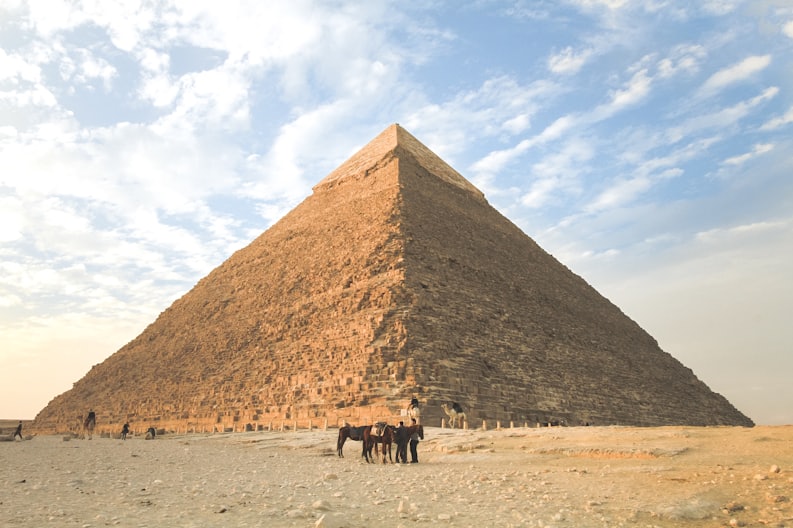
The Old Kingdom (2686–2181 BCE, Dynasties III–VI) produced the most immediately recognisable monuments in human history: the step pyramid of Djoser at Saqqara, designed by Imhotep and the first large stone building in the world; and the three great pyramids of Giza — Khufu, Khafre and Menkaure — built within a single century in the Fourth Dynasty. The logistics of these projects — the quarrying, transport and placement of millions of limestone and granite blocks — are better understood than popular accounts suggest, thanks to decades of excavation at the workers' village near Giza.
The Old Kingdom is also the period in which the theology of Egyptian kingship reaches its fullest expression. The pharaoh is literally divine — an embodiment of Horus in life and Osiris in death — and the state apparatus, from the agricultural tax system to the mortuary priesthoods, is organised around sustaining that divinity and the cosmic order it guarantees. The Pyramid Texts, inscribed inside Fifth and Sixth Dynasty pyramids, are the oldest surviving body of religious literature in the world and the ancestor of the later Coffin Texts and Book of the Dead.
The period ends with a collapse — a combination of climate deterioration, reduced Nile floods, and a fragmentation of central authority under the long reign of Pepi II — that ushers in the First Intermediate Period. Our Old Kingdom coverage includes pyramid construction methods, the administration of the royal estate, and the key pharaohs of Dynasties III through VI.
Middle Kingdom — reunification and a literary golden age
The Middle Kingdom (2055–1650 BCE, Dynasties XI–XIII) begins with the reunification of Egypt under Mentuhotep II of Thebes, who ends the First Intermediate Period's fragmentation and re-establishes a single royal authority. The period that follows is regarded by Egyptologists as a high point of Egyptian culture in several respects: the literature of the Middle Kingdom — the Story of Sinuhe, the Eloquent Peasant, the Shipwrecked Sailor — is both artistically sophisticated and psychologically complex in ways that continue to reward close reading.
Politically, the Middle Kingdom sees significant expansion into Nubia, with a chain of fortresses built along the Second and Third Cataracts of the Nile to control trade routes in gold, ivory and slaves. Amenemhat I, founder of Dynasty XII, moves the capital north to Itjtawy, near modern Lisht, and inaugurates a succession of strong rulers who stabilise the state and expand Egyptian commercial reach into the Levant, Punt and the Eastern Mediterranean.
The end of the Middle Kingdom is complex: Dynasty XIII sees a rapid succession of short-lived pharaohs, and the Second Intermediate Period brings the Hyksos — a people of West Asian origin — to power in the north. Our Middle Kingdom coverage includes the literary texts (with translations), the Nubian fortresses, the administration of the Fayum irrigation project, and the shift in funerary practice that democratised access to afterlife texts previously reserved for royalty. See also the related full timeline.
New Kingdom — Egypt at its most powerful
The New Kingdom (1550–1069 BCE, Dynasties XVIII–XX) is the period most Egyptians and most tourists think of first. It is the time of the empire — Egyptian armies campaigning into Syria-Palestine and deep into Nubia, diplomatic correspondence with the kings of Babylon, Mitanni and the Hittites, and a royal court of extraordinary wealth sustained by tribute, trade and the gold mines of Kush.
The pharaohs of this era include some of the most studied individuals in history: Hatshepsut, who ruled as pharaoh in her own right and whose monuments at Deir el-Bahri represent some of the finest architecture in Egypt; Thutmose III, the military strategist who led seventeen campaigns into the Levant and created the empire's greatest extent; Akhenaten, who abandoned the traditional pantheon in favour of the single solar deity Aten and moved the capital to the purpose-built city of Akhetaten (modern Amarna); and Ramesses II, whose 67-year reign left more surviving monuments than any other ruler. Tutankhamun belongs to this dynasty, his fame inverse to his importance — a short-reigned successor to Akhenaten whose undisturbed tomb, discovered by Howard Carter in 1922, remains the richest archaeological find in Egyptian history.
The New Kingdom ends as the Late Bronze Age collapses across the Eastern Mediterranean — a combination of Sea Peoples migrations, internal fragmentation and the withdrawal of Nubian gold income that leaves Egypt diminished and eventually divided. Explore the key figures in the pharaohs section and the Amarna religion in the religion and afterlife topic.
Third Intermediate & Late Period — foreign pharaohs and the Saite renaissance
The Third Intermediate Period (1069–664 BCE, Dynasties XXI–XXV) is the most neglected era in popular Egyptian history, which is a pity because it is one of the most historically complex. Egypt is effectively divided between a line of pharaohs ruling from Tanis in the Delta and a parallel series of High Priests of Amun controlling Thebes and Upper Egypt — a religious-political settlement that survives, improbably, for several generations. Libyan chieftains then take the throne (Dynasties XXII–XXIII), followed by the Nubian kings of Dynasty XXV, who rule all of Egypt and present themselves as restorers of true pharaonic tradition.
The Late Period (664–332 BCE, Dynasties XXVI–XXXI) begins with the Saite revival under Dynasty XXVI — a conscious return to Old and Middle Kingdom artistic models, a period of relative stability and Egyptian commercial expansion into the Greek world. Persian conquest comes twice (Dynasties XXVII and XXXI), interrupted by a period of native rule. Greek mercenaries and settlers, particularly in the Delta city of Naucratis, create the cultural contacts that will make the subsequent Macedonian conquest less alien than it might otherwise have been.
Our coverage of this long and complex period includes the Tanis royal tombs (found intact in 1939 and almost as rich as Tutankhamun's), the Nubian pharaohs' construction campaigns at Jebel Barkal, and the Persian administrative records that shed light on how Egypt was governed under Achaemenid rule. These eras are covered in the dynasties section in full.
Ptolemaic Egypt — Greek kings and the last pharaohs
When Alexander the Great took Egypt from the Persians in 332 BCE he was welcomed rather than resisted, and his successors — the Ptolemaic dynasty founded by his general Ptolemy I Soter — would rule Egypt for nearly three hundred years, until Cleopatra VII's death in 30 BCE brought the independent Egyptian state to a permanent end.
The Ptolemies ruled as pharaohs in the traditional sense: they built temples in the Egyptian style, conducted rituals at Egyptian shrines and bore Egyptian royal names alongside their Greek ones. The Temple of Horus at Edfu and the Temple of Hathor at Dendera — among the best-preserved ancient Egyptian temples standing today — are Ptolemaic constructions. At the same time Alexandria, the new capital on the Mediterranean coast, became the intellectual capital of the Hellenistic world: home to the Library of Alexandria, the Museum (a research institution in the modern sense), and a population that was Greek, Egyptian, Jewish and increasingly multilingual.
The Rosetta Stone — the key to deciphering hieroglyphs — is a Ptolemaic document: a priestly decree from 196 BCE, issued in the reign of Ptolemy V, written in hieroglyphs, Demotic and Greek. Our Ptolemaic coverage includes the dynasty's relationship with Egyptian religion, the administrative bilingualism of the period, and the reign of Cleopatra VII in particular — whose story is far more politically complex than most popular treatments suggest. Read about the decipherment of the script in the hieroglyphs section.
Hieroglyphs and the Egyptian language
Egyptian hieroglyphs are one of the world's oldest writing systems, in use from approximately 3200 BCE to 394 CE — a continuous tradition of over three and a half thousand years. What makes the script fascinating is its structural complexity: it is not an alphabet, but it is not purely pictographic either. It combines phonetic signs (which represent sounds) with logograms (which represent whole words or concepts) and determinatives (silent signs that indicate the category of a word). The same sign can function differently depending on context.
The language itself evolved substantially over three millennia, from the Old Egyptian of the Pyramid Texts through Middle Egyptian (the classical literary language), Late Egyptian (the language of the New Kingdom administration), Demotic (a cursive script used for administrative and legal documents from the 7th century BCE), and finally Coptic — the latest stage of the language, written in a Greek-derived alphabet and still used liturgically in the Coptic Orthodox Church today.
The decipherment of hieroglyphs by Jean-François Champollion in 1822 — building on the trilingual text of the Rosetta Stone and the earlier work of Thomas Young — is one of the great intellectual achievements of the 19th century. Our hieroglyphs section covers the structure of the script in detail, walks readers through reading a royal cartouche, explains the mechanics of Champollion's breakthrough, and introduces the major categories of hieroglyphic inscription. A practical guide to the most common signs is included for readers who wish to begin recognising them on monuments.

Religion, gods and the afterlife
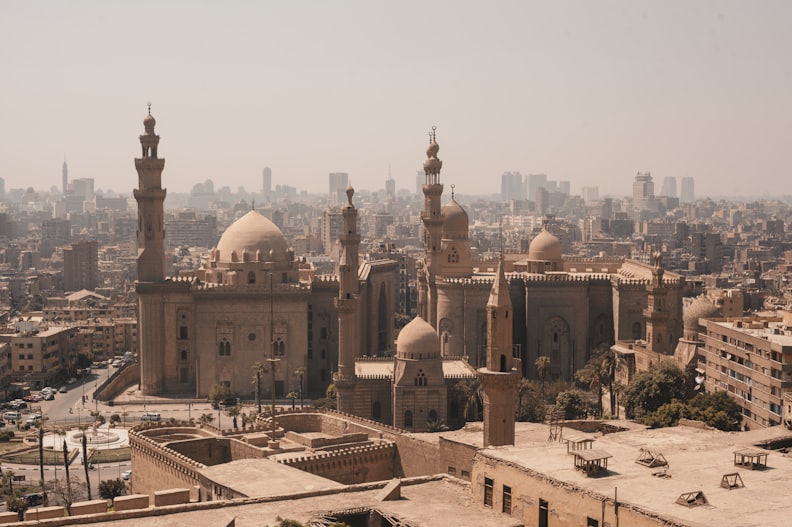
Egyptian religion is not a single, uniform system but a layered accumulation of regional cults, royal theologies and popular belief that coexisted, evolved and occasionally conflicted over three thousand years. The major deities — Ra, Osiris, Isis, Horus, Anubis, Thoth, Hathor, Seth, Sekhmet, Ptah and dozens more — are not simply gods in a pantheon but embodiments of cosmic principles whose relationships with each other encoded the Egyptians' understanding of the universe, the state and the individual human life.
The Osiris myth — in which Osiris is murdered by Seth, reassembled by Isis, and resurrected to rule the underworld, while their son Horus defeats Seth and takes the earthly throne — is the central narrative of Egyptian religion and the theological basis of kingship itself. Every pharaoh was Horus in life and became Osiris at death. The same story underpins the funerary tradition: mummification, the weighing of the heart against the feather of Ma'at, and the elaborate textual guides to the underworld that developed from the Pyramid Texts through to the Book of the Dead.
Our coverage of gods and mythology includes profiles of the major deities, the texts of the main mythological cycles, a detailed account of the Amarna period's disruption of traditional religion under Akhenaten, and a guide to the funerary tradition from predynastic burial practice through to the Ptolemaic period. The section on the afterlife explains the mechanics of mummification with reference to the actual procedures described in surviving texts and confirmed by modern analysis of mummies.
Daily life and society
The Egypt of the monuments is the Egypt of the pharaohs and the priesthood — but most Egyptians were farmers, scribes, craftsmen, soldiers, traders and domestic workers whose lives are recoverable, at least partially, through the extraordinary survival of everyday documents on papyrus and ostraca (pottery sherds used as cheap writing surfaces), through tomb paintings commissioned to provision the deceased's afterlife with images of everyday activity, and through the physical remains of ordinary settlements at sites like Deir el-Medina, the Kahun workers' town and Amarna.
Bread and beer were the dietary staples for all social classes; grain rations were the standard unit of payment for non-agricultural labour. The Nile flood — which deposited a layer of fertile silt across the floodplain each summer before retreating — dictated the agricultural calendar and, more broadly, the rhythm of Egyptian life. When it failed, as it did during the Old Kingdom's collapse, famine followed. When it rose too high, settlements flooded. The Egyptians' relationship with the river was one of gratitude, management and anxiety simultaneously.
Our daily life section covers food, clothing, housing, family structure, the education of scribes, the status of women (higher than in most contemporary cultures), the organisation of craft workshops, the medical knowledge of Egyptian physicians, and the leisure activities — board games, music, hunting in the marshes — visible in tomb art. The administrative documents from Deir el-Medina, which record work stoppages, sick days and even a recorded strike, give a particularly vivid picture of organised labour in the New Kingdom.
Art and architecture
Egyptian art is immediately recognisable across three thousand years — the figures in profile, the hierarchical scale (larger figures are more important), the register-based composition of narrative scenes, the restricted palette of six primary pigments. That consistency is not artistic conservatism but theological discipline: Egyptian art was not primarily decorative but functional, creating a permanent record of rituals, battles, offerings and the afterlife that would remain effective regardless of whether the original event had taken place. The image of a pharaoh triumphing over enemies was as real, in its effects, as the battle itself.
Architecture followed similarly consistent principles across millennia: the pylon gateways, hypostyle halls and sanctuary sequence of a New Kingdom temple at Karnak reproduce in stone the same spatial logic as a Middle Kingdom predecessor, because both are modelling the cosmos through which the ritual progression moves. The differences are of scale and refinement rather than kind. The Ptolemaic temples at Edfu and Dendera are so well-preserved precisely because the theological programme they embody — and therefore the architectural envelope required to contain it — had remained fundamentally stable for fifteen centuries.
Our art and architecture coverage includes a guide to reading Egyptian compositional conventions, a period-by-period survey of stylistic development from the Narmer Palette to the Ptolemaic reliefs, an account of how monuments were planned and built, and specific analyses of the major sites: Karnak, Luxor, Abu Simbel, Abydos, Medinet Habu, Deir el-Bahri and the Giza plateau. Linked to the study guides which include structured visual analysis exercises for classroom use.
The rediscovery of Egypt — the history of Egyptology
Egypt was never entirely forgotten in the Western tradition — the classical authors wrote about it, the Bible names it repeatedly, and the obelisks carried to Rome ensured its monumental presence in Europe from the first century CE onwards. But Egypt's own writing system was unreadable from the fourth century CE, when the last hieroglyphic inscription was carved at Philae, until Champollion's decipherment in 1822. In that interval, an enormous body of speculation, often fanciful and sometimes deliberately fraudulent, accumulated around the mute monuments.
Napoleon's Egyptian campaign of 1798–1801, which included a team of 167 scholars, artists and scientists — the "savants" whose observations were published in the monumental Description de l'Égypte — marks the beginning of systematic modern study. The discovery of the Rosetta Stone by French soldiers at Fort Julien near Rosetta in 1799 provided the key. Thomas Young in England identified the phonetic principle; Champollion in France worked out the full system, publishing his findings in his celebrated letter to M. Dacier in 1822.
The 19th century saw both extraordinary discovery and extraordinary damage: Belzoni's explosive clearing of tombs, the stripping of papyri from Fayum mummies for the antiquities market, and the dynamiting of pyramid interiors. Flinders Petrie's introduction of stratigraphic excavation — recording finds by layer, not just by value — transformed the discipline from treasure-hunting into archaeology. Our Egyptology history section covers this story in full, including the ongoing debates about repatriation of objects currently held in European and American museums. Useful background for the hieroglyphs and dynasties sections.

The pharaohs — rulers as historical figures
The word "pharaoh" (from Egyptian per-aa, "great house") originally referred to the royal palace rather than the king himself, and only became a standard title for the ruler during the New Kingdom. Before that, kings were identified by their Horus name, their Nebty name, their Golden Horus name, their prenomen and their nomen — a complex system of royal titulary that encoded their divine nature and their relationship to the major gods. Understanding this system is necessary for working with king lists and cross-referencing ancient texts.
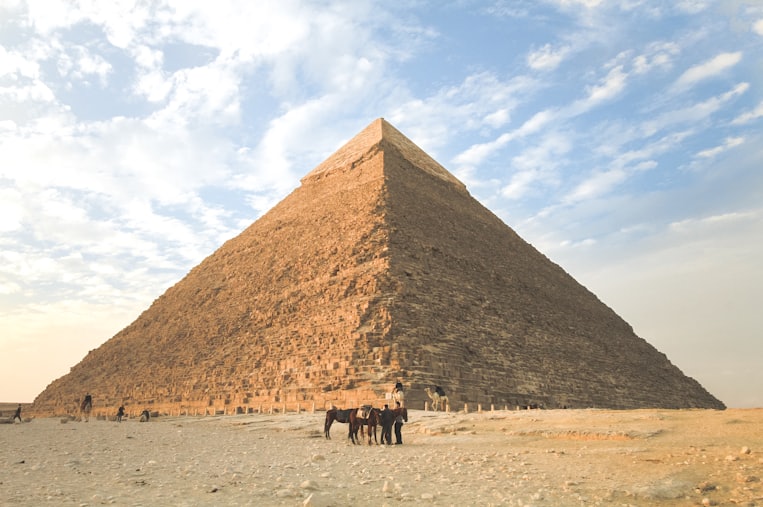
Our pharaohs section covers 42 individual rulers in detail, from Narmer through Cleopatra VII, with particular attention to separating historical evidence from later legend and popular culture. Khufu, for example, is attested primarily through his pyramid and a fragmentary ivory figurine — the monumental record of Egypt's greatest builder is paradoxically thin. Ramesses II, by contrast, left more inscriptions than any other ruler, many of them propagandistic accounts of the Battle of Kadesh that require careful reading. Hatshepsut's systematic erasure from monuments by her successor Thutmose III — and the scholarly debate about his motives — is treated in detail.
The section includes a complete king list with dates, a guide to reading royal cartouches, and profiles of the pharaohs most commonly encountered in curricula: Djoser, Khufu, Hatshepsut, Thutmose III, Akhenaten, Tutankhamun, Ramesses II and Cleopatra VII. Each profile cross-references the relevant dynastic and topical coverage elsewhere on the site, making it possible to move between the religious context, the social setting and the political biography without losing the thread.
Start reading — free access to all topics
All twelve subject areas are freely readable in full. If you are a teacher looking for structured classroom materials, the study plans add worksheets and lesson packs. If you have a specific question, write to us.
Open the full timeline Browse study guides